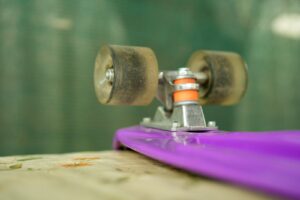

A flexible longboard deck bends noticeably under the rider and can feel lively and forgiving. A stiff deck holds its shape more closely, giving a direct and predictable platform. Neither is universally better: the right choice depends on rider weight, wheelbase, construction, riding style, speed, and the amount of ground clearance the complete board has.
For relaxed carving and some distance or dancing setups, controlled flex can add comfort and rebound. For downhill, technical freeride, hard landings, or any setup where deck movement could cause contact with the ground or components, greater stiffness is usually the safer and more predictable direction.
Flex vs stiff at a glance
| Characteristic | More flexible deck | Stiffer deck |
|---|---|---|
| Ride feel | Lively, spring-like, more isolated from small vibration | Direct, solid, immediate |
| Carving | Can add rebound and a surf-like rhythm | Relies more on trucks and bushings for the turning feel |
| High-speed control | Movement may be harder to manage | More consistent platform |
| Pushing clearance | Can sag closer to the ground under load | Maintains clearance more consistently |
| Tricks and landings | Can absorb some load but may feel imprecise if excessive | Predictable takeoff and landing platform |
| Weight sensitivity | Highly sensitive to rider weight and stance | Usually works across a wider load range, within its rating |
What determines how much a deck flexes?
“Flex” is not a standardized number across the longboard industry. A Flex 1 from one brand cannot be assumed to match a Flex 1 from another. Compare only within the manufacturer’s own range and follow its current rider-weight guidance.
- Rider weight: More load generally creates more deflection.
- Wheelbase: A longer unsupported span tends to flex more than a shorter one with similar materials and thickness.
- Construction: Number and orientation of wood plies, fiberglass, bamboo, carbon fiber, and other laminates change stiffness and rebound.
- Deck profile: Concave, bends, drops, and molded features can stiffen parts of a deck.
- Mounting style: Top-mount, drop-through, and bracket arrangements load a deck differently.
- Age and condition: Water damage, delamination, cracks, and repeated heavy loading can change how a deck behaves.
Loaded Boards, for example, publishes model-specific weight ranges and distinguishes flex options within individual products. That is the useful kind of guidance: tied to a particular construction and wheelbase, not generalized to every deck.
When a flexible longboard makes sense
Controlled flex can suit cruising and carving because the deck stores and releases energy as the rider moves through turns. Some riders also value the extra vibration isolation on rough pavement. A flexy platform may work for dancing when it remains supportive enough for cross-steps and tricks, but preference varies: excessive bounce can make footwork and landings less precise.
For distance riding, flex is a trade-off. It can improve comfort, yet too much sag reduces clearance and may waste energy or allow the deck to strike obstacles. Low drop decks need particular attention because they start closer to the pavement. Compare deck shape and mounting options in the types of longboards guide.
When a stiff longboard is the better choice
A stiff deck provides a consistent reference underfoot. That matters as speed, cornering load, or landing force increases. Downhill and freeride riders generally benefit from a platform that does not add an uncontrolled oscillation to the steering system. A stiff deck is also appropriate when a battery enclosure, drivetrain, or other rigid component cannot tolerate deck bending.
Stiffness alone does not make a board stable. Truck geometry, bushings, wheels, stance, and rider skill remain central. Use the longboard trucks guide and bushing guide when diagnosing handling rather than expecting the deck to correct the full setup.
Choose by riding style
| Riding goal | Useful starting direction | Why |
|---|---|---|
| Casual cruising | Mild to moderate flex | Comfort and a lively feel, if clearance remains adequate |
| Carving | Controlled flex or medium-stiff | Choice depends on whether you want deck rebound or a truck-led feel |
| Distance pushing | Supportive flex to stiff | Avoid excess sag on low decks and preserve efficient pushing |
| Dancing | Manufacturer-rated flex for your weight | Enough rebound for feel without an unstable platform |
| Freestyle | Medium-stiff to stiff | More predictable pop and landings |
| Freeride | Stiff | Consistent platform during setup turns and slides |
| Downhill | Stiff | Predictability under speed and cornering load |
| Electric | System-specific | Deck flex must be compatible with enclosures, wiring, battery, and drivetrain |
These are selection directions, not certifications. Always stay within the deck maker’s rider-weight limit and intended discipline.
How to choose the correct flex rating
- Define the primary use. Choose for the most demanding riding you realistically plan to do, not the easiest part of the ride.
- Use total riding load. Include your body weight plus a backpack or carried gear when comparing a manufacturer’s range.
- Check the exact model chart. Flex labels are brand- and model-specific.
- Consider stance and wheelbase. A wide stance and long wheelbase can load the center more strongly.
- Check minimum clearance. Account for the deck bending under your actual riding load.
- Choose more support when uncertain about speed or impact. Do not use an excessively flexible deck outside its intended discipline.
A practical flex and clearance check
Wear shoes and the gear you normally carry. On a flat surface, have another person steady the board while you stand in your normal stance. Load the center gradually without bouncing. Observe the lowest point of the deck and check clearance to the ground, wheels, trucks, and any mounted hardware. Stop if you hear cracking, see delamination, or feel a sudden change in resistance.
This static check cannot reproduce every dynamic load, so begin riding slowly on smooth, traffic-free pavement. Progress gradually and inspect again after the first sessions. The U.S. Consumer Product Safety Commission recommends checking a skateboard before riding and using protective equipment; see its skateboard safety guidance.
Common mistakes
- Buying by a generic flex label: compare the manufacturer’s weight range for the exact model.
- Ignoring total load: a heavy backpack changes deck deflection.
- Assuming flex automatically means comfort: wheels, bushings, deck height, and pavement also determine comfort.
- Using a speed-oriented setup because it feels stable at walking pace: low-speed feel does not prove high-speed control.
- Confusing flex with damage: new noises, soft spots, cracks, or delamination require inspection.
- Deck-swapping an electric board without engineering checks: bending can strain enclosures, wiring, and mounting points.
Flex, wheels, and bushings work together
Deck flex changes vertical movement and underfoot feel; bushings control truck lean and resistance; wheels influence grip, vibration, and obstacle rollover. A harsh ride is not necessarily a deck problem, and a vague turn is not necessarily caused by flex. Change one component at a time and retest. The wheel guide explains size and durometer trade-offs.
Frequently asked questions
Is a flexy longboard easier for beginners?
Not automatically. Mild flex can feel comfortable, but too much movement can make balance and pushing less predictable. Beginners should prioritize a deck rated for their weight, adequate width and clearance, and a controllable truck setup.
Does a stiff deck ride faster?
Stiffness does not directly set speed. Wheels, bearings, terrain, aerodynamics, pushing, and drivetrain on an electric board all matter. A stiff platform is favored for speed because it behaves more consistently, not because stiffness itself creates speed.
Can a longboard be too stiff?
Yes, for the rider’s preference and intended use. A very stiff deck may feel less lively or transmit more road vibration. That can be a comfort trade-off while still being structurally appropriate.
Bottom line
Choose flex for the complete system and the riding goal. Controlled flex can improve comfort and carving feel; stiffness improves platform consistency for speed, slides, impacts, and rigid electric components. Use the exact deck maker’s rider-weight range, include carried gear, verify clearance, and inspect any unexpected change before riding again.