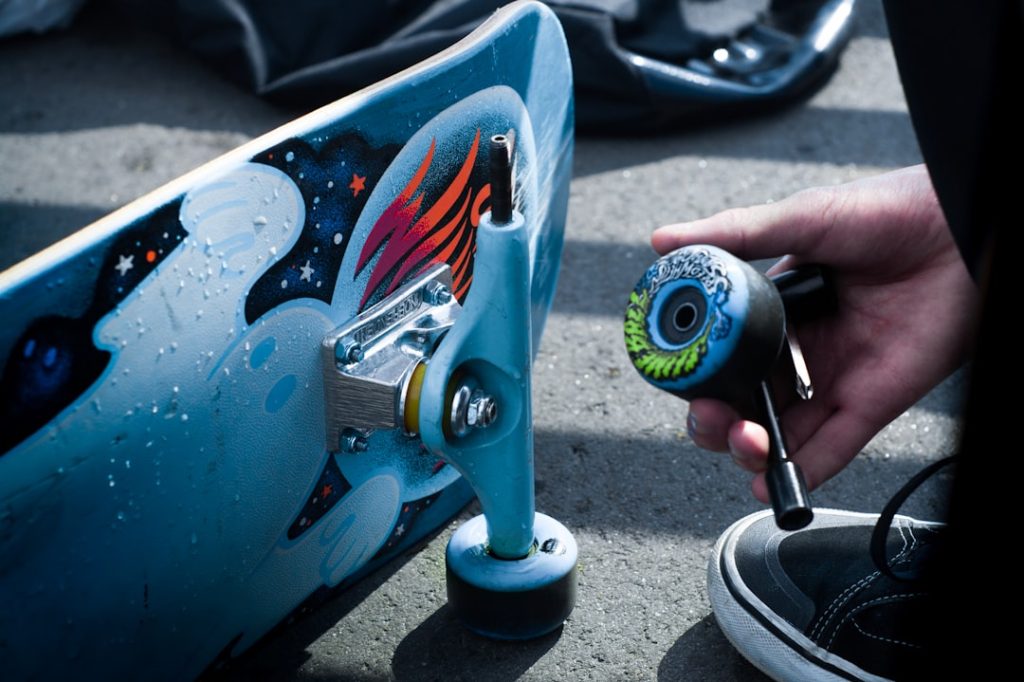
Longboard trucks determine how a board turns, holds speed and responds under your feet. Choosing them is easier when you separate five variables: truck style, hanger width, baseplate angle, bushing setup and how the trucks mount to the deck.
Reverse kingpin vs traditional kingpin
Reverse-kingpin trucks place the kingpin toward the outside and are standard on many full-size longboards. They offer predictable geometry and easy bushing tuning. Traditional-kingpin trucks are compact and suit smaller cruisers, where clearance and tight turning matter more than high-speed stability.
Choosing hanger width
Match the axle width approximately to the deck width at the trucks. A much wider truck can feel stable but increases leverage and the chance of kicking a wheel. A narrow truck turns more quickly but may feel less planted. Common longboard widths include roughly 150–180 mm, but deck shape and discipline decide the correct choice.
Baseplate angle explained
Higher angles generally create more turn for a given lean; lower angles create less turn and more directional stability. A 50-degree setup is versatile for cruising and carving. Lower rear angles are common in directional downhill setups. Avoid judging stability from angle alone because bushings, wheelbase and rider position also matter.
Truck placement and mounting
Most longboards use standard mounting holes and either top-mount or drop-through installation. Trucks should sit flat against the deck with undamaged hardware. Tighten mounting nuts evenly and stop when the hardware is secure; crushing the deck weakens the mounting area. Check truck orientation before riding.
Bushings and rider weight
Bushings control resistance and return-to-center. Softer formulas turn with less force; harder formulas provide more support. Shape matters too: barrels are supportive, cones are responsive and eliminator-style bushings restrict movement. Use manufacturer weight charts as a starting point, then tune one change at a time.
Setup for cruising and carving
A symmetrical 50-degree reverse-kingpin setup with medium-soft bushings works for many riders. Prioritize wheel clearance and comfortable lean. The goal is controlled response—not the loosest possible trucks.
Setup for freeride and downhill
Freeride riders often want supportive bushings and defined center while retaining enough turn for speed checks. Downhill setups may use a lower rear angle, harder rear bushings and precision components. These choices require experience and should never replace protective equipment and progressive practice.
Common setup mistakes
Frequent mistakes include mixing mismatched truck widths, overtightening bushings, forgetting speed rings, mounting both trucks in the wrong orientation and solving wheelbite only by tightening. Risers, smaller wheels or a compatible deck may be the proper fix.
Frequently asked questions
Should trucks be wider than the longboard deck?
Aim for the wheel edges to sit close to the deck width. Small differences are normal, but a large mismatch changes leverage and handling.
Do longboard trucks fit every deck?
Most use standard mounting patterns, but drop-through cutouts, old-school hole patterns and deck width can limit compatibility.
What trucks are best for carving?
Responsive reverse-kingpin trucks near 50 degrees are a common choice, paired with bushings suited to rider weight.