Electric longboard wheels must fit both the board and its drivetrain. Diameter, tire construction, core, pulley or motor interface, bearings, axle, clearance, and electronic wheel settings can all affect acceleration, braking, speed reporting, motor load, range, and handling. A wheel that physically slides onto an axle is not necessarily compatible.
Start with the board manufacturer’s approved wheel list. If you move outside it, verify the exact board revision, drive type, wheel variant, pulley or adapter, belt length, axle hardware, clearance, gearing, and required remote or app settings before riding.
Electric longboard wheel types
| Wheel type | Typical strengths | Main trade-offs | Compatibility focus |
|---|---|---|---|
| Street urethane | Direct road feel, low weight, efficient rolling on smooth pavement | Less isolation from cracks and rough surfaces | Core, pulley, bearings, diameter, and deck clearance |
| Hub-motor sleeve | Compact powered-wheel format with few exposed drive parts | Thin urethane, model-specific fit, limited wheel choice | Exact motor shell, keying, fasteners, and board model |
| Cloud-style or airless wheel | More compliance and obstacle isolation than typical street urethane | Added mass and rolling behavior can change range and handling | Correct hub, pulley or direct-drive adapter; clearance |
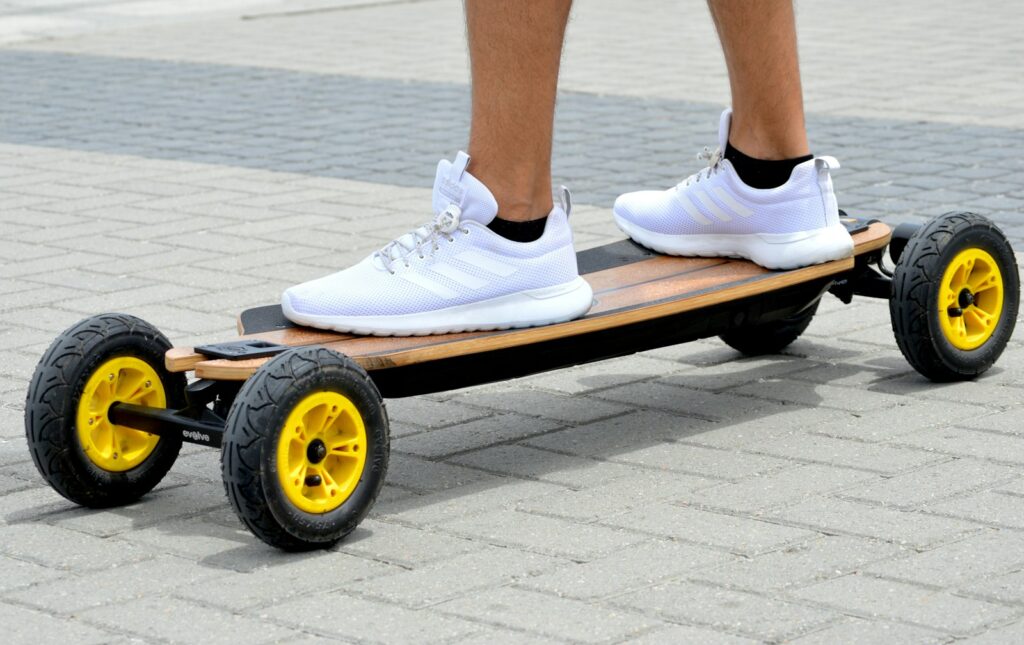
| Pneumatic tire | Comfort and traction on rough terrain; tire pressure can be tuned | Punctures, pressure maintenance, more rotating mass and rolling resistance | Hub, tire, tube, pulley, belt, axle, truck, and enclosure clearance |
| Solid all-terrain tire | No air-pressure checks or pinch flats | Weight, vibration, grip, and deformation vary widely | Dedicated hub or adapter, gearing, and clearance |
For conventional longboard wheel fundamentals—lip shape, contact patch, urethane behavior, and general durometer trade-offs—use the longboard wheels guide. This page focuses on powered-board interfaces.
Drive type determines the first compatibility check
Belt drive
A belt-drive wheel needs a compatible wheel core and wheel pulley. Confirm the core pattern, pulley attachment, pulley bearing if used, pulley offset, tooth count, belt profile and width, required belt length, axle space, and motor-mount adjustment range. A pulley sold for one family of cores may not fit a visually similar clone.
Hub drive
The driven rear wheels are motor sleeves, not ordinary wheels. Match the exact hub-motor diameter, shell shape, keying or indexing, fastener arrangement, and board generation. Manufacturer listings often name the supported models; for example, current replacement-sleeve pages from Exway and Backfire identify specific board families rather than claiming universal fit. Front wheels may also need to match the rear diameter and ride characteristics.
Direct drive
Direct-drive motors usually require a wheel adapter that fits both the motor interface and the wheel core. Check adapter type, retention method, axle hardware, motor clearance, wheel offset, and whether the selected wheel leaves enough urethane or tire clearance around the motor.
Gear drive
A gear-drive system may use proprietary wheel hubs, gear carriers, or adapters. Follow its documentation for wheel diameter, hub, gear ratio, lubrication, enclosure clearance, and assembly. Do not assume advice for a belt pulley applies to a gear drive.
Wheel diameter changes the drivetrain
With motor speed and gearing unchanged, a larger wheel travels farther per revolution. That tends to raise theoretical road speed while reducing force at the road and changing braking leverage. A smaller wheel tends in the opposite direction. Real results remain limited by motor, controller, battery, load, drag, temperature, and firmware.
Do not treat a larger wheel as a free speed upgrade. It may reduce acceleration and braking response, increase current demand in some riding conditions, alter motor temperatures, increase rotating mass, and make displayed speed or distance inaccurate until the board is configured correctly.
How pulley ratio interacts with wheel size
For a belt drive, a common reduction-ratio convention is:
Reduction ratio = wheel-pulley teeth ÷ motor-pulley teeth
With the same motor pulley and wheel, a larger wheel pulley creates more reduction: generally more force at the wheel and lower theoretical top speed. A smaller wheel pulley creates less reduction: generally less force at the wheel and higher theoretical top speed. Changing wheel diameter at the same time changes the final result again.
There is no universal pulley tooth count for a wheel diameter. Motor characteristics, voltage, total load, hills, tire rolling resistance, belt clearance, controller limits, and desired braking all matter. Linnpower’s belt and gear-ratio guide is a useful example of manufacturer-specific guidance, including its recommendation to reconsider pulley size when fitting larger wheels to its systems.
Will larger electric skateboard wheels reduce range?
There is no fixed percentage. A wheel swap can change diameter, mass, deformation, contact behavior, rolling resistance, gearing, speed, acceleration habits, motor operating point, and tire pressure. Range also changes with rider weight, hills, surface, wind, temperature, battery age, and riding mode.
- Large pneumatic or highly compliant wheels often consume more energy than efficient street urethane in comparable conditions.
- Frequent acceleration makes wheel mass and gearing especially relevant.
- Higher available speed can reduce range if the rider uses it.
- Low pneumatic pressure generally increases deformation and rolling resistance; excessive pressure reduces compliance and must never exceed tire or rim limits.
- A claimed range result from another board is not transferable without matching the complete setup and test conditions.
Measure your own baseline on a repeatable route before and after the change, keeping riding mode, speed, load, tire pressure, and weather as consistent as practical. Plan a reserve rather than riding to electrical cutoff.
Urethane, airless, or pneumatic?
| Priority | Useful starting direction | Reason |
|---|---|---|
| Efficiency on smooth pavement | Compatible street urethane | Lower mass and deformation can favor efficient rolling |
| Compact commuter setup | Street urethane or model-specific compliant wheel | Balances portability and pavement tolerance |
| Broken pavement | Larger compliant or pneumatic option | Improves obstacle isolation, with range and weight trade-offs |
| Loose or mixed surfaces | Approved pneumatic or all-terrain system | Tread, diameter, and compliance may improve control |
| Minimum maintenance | Urethane or solid option | Avoids tire pressure and punctures, but still requires inspection |
“All-terrain” does not mean safe on every trail, wet surface, loose descent, or public route. For non-electric wheel construction and terrain considerations, see the off-road longboard wheels guide.
Core and adapter compatibility
Wheel cores that look similar may differ in spoke count, spoke thickness, depth, bearing-seat position, offset, tolerances, and material. A pulley or adapter must seat fully without forcing, rocking, distorting the wheel, or interfering with the bearing. Cloudwheel’s current model-based buying guide demonstrates the correct purchasing approach: choose by board and drive variant, not diameter alone.
- Confirm the exact core name and generation.
- Use the pulley or adapter part number specified for that wheel and board.
- Check whether the adapter is press-fit, bolt-on, keyed, or bearing-supported.
- Use every supplied spacer, washer, sleeve, and fastener in the instructed order.
- Reject a part that requires improvised drilling or grinding unless the manufacturer explicitly documents that procedure.
Bearings, axles, and wheel nuts
Verify bearing inner and outer dimensions, spacer length, speed-ring placement, axle diameter and usable length, wheel offset, and nut engagement. Powered rear-wheel assemblies may use different hardware from the front wheels. Tighten to the manufacturer’s procedure: the wheel should be secure and rotate as designed without bearing bind or side-to-side looseness.
After the first short ride, recheck wheel nuts, pulley fasteners, adapters, belts, and any model-specific retention screws. Do not use a powered wheel with a cracked core, loose sleeve, damaged bearing seat, missing fastener, or unexplained wobble.
Wheelbite and ground clearance
Larger wheels can approach the deck during steering. Pulleys, belts, motors, and gear housings can also approach the ground. Test the full system under realistic static load before riding, then validate at walking speed. Dynamic loads can compress and lean the board farther than a gentle hand test.
- Turn both trucks through their loaded steering range.
- Check wheel-to-deck, wheel-to-enclosure, motor-to-deck, pulley-to-ground, and belt-to-ground clearance.
- Inspect cable routes at full steering lock.
- Account for deck flex and bushing compression.
- Use only risers and hardware compatible with the deck and truck setup.
Wheelbite can stop a wheel abruptly. If clearance is inadequate, do not merely tighten the trucks until they barely turn. Correct the wheel, bushing, riser, deck, or truck combination. The longboard bushings guide explains how support and washer choice affect available lean.
Update wheel and gear settings
Some boards calculate speed, distance, motor behavior, or telemetry using stored wheel and gear values. Enter only supported settings using the official manual. Evolve’s GTR manual, for example, instructs users to select the correct wheel and gear size after a change. The exact process and available combinations are model-specific.
An apparently correct speed display does not prove that a wheel is mechanically or electrically supported. Do not use undocumented settings to override compatibility limits, and verify braking gently after any wheel or gearing change.
Pneumatic tire setup
- Match tire, tube, and hub or rim dimensions exactly.
- Observe any directional tread or sidewall marking.
- Seat both hub halves and the tire bead according to the maker’s instructions.
- Keep the tube clear of pinch points during assembly.
- Use only the tire and system’s specified pressure range; the lowest printed limit among compatible components governs.
- Check pressure cold with a suitable gauge before riding.
- Carry the correct repair or spare parts only if you know the approved procedure.
Stop for a rapid pressure loss, bulge, cut, exposed reinforcement, cracked hub, bent fastener, or repeated imbalance. A powered board can load a damaged tire during acceleration and regenerative braking as well as cornering.
Installation and first test
- Power the board off and follow the manufacturer’s battery-isolation procedure.
- Record the original wheel, pulley, belt, spacer, washer, and setting configuration.
- Inspect new parts and compare every part number with the compatibility list.
- Install bearings, adapters, pulleys, sleeves, tires, and hardware in the documented order.
- Set belt alignment and tension where applicable.
- Rotate each wheel by hand and check for rub, bind, wobble, and cable contact.
- Check loaded wheelbite and drivetrain ground clearance.
- Update supported wheel and gear settings.
- Wear protective equipment and test acceleration, coasting, turning, and braking at walking speed away from traffic.
- Increase speed gradually while monitoring heat, noise, vibration, and braking behavior.
- Reinspect the complete assembly after the first short ride.
Maintenance checklist
| Part | Inspect for |
|---|---|
| Urethane or sleeve | Chunking, separation, cracks, severe flat spots, or looseness on the core or motor |
| Pneumatic tire | Pressure loss, cuts, bulges, tread damage, or bead movement |
| Core or hub | Cracks, distortion, loose fasteners, or damaged adapter interface |
| Bearings | Roughness, play, noise, contamination, or damaged seats |
| Pulley and belt | Tooth wear, debris, misalignment, damage, and incorrect tension |
| Wheel hardware | Loose nuts, missing washers, poor thread engagement, or movement |
Common mistakes
- Buying by diameter without checking the drive interface
- Assuming every ABEC-style or similar-looking core is identical
- Installing larger wheels without reviewing pulley ratio and braking
- Forgetting to update supported wheel and gear settings
- Ignoring pulley, motor, belt, or enclosure ground clearance
- Mixing tire, tube, and hub sizes
- Running pneumatic tires outside documented pressure limits
- Using generic range percentages as guaranteed results
- Testing top speed before low-speed braking and clearance checks
Frequently asked questions
Can I put regular longboard wheels on an electric longboard?
Sometimes on a compatible belt or direct-drive system with the correct core, pulley or adapter, bearings, hardware, gearing, and clearance. Hub motors require dedicated sleeves or compatible conversion products. Check the exact board model and generation.
Do bigger wheels make an electric longboard faster?
With unchanged gearing they increase theoretical distance per wheel revolution, but real speed may be limited by power, load, drag, temperature, firmware, and voltage. Acceleration and braking leverage also change, so diameter is not a safe stand-alone speed upgrade.
Are pneumatic wheels safer?
They can improve comfort and control on some rough surfaces, but they add pressure, puncture, tire seating, hub, clearance, and maintenance risks. Safety depends on terrain, speed, setup quality, tire condition, and rider skill—not tire type alone.
Bottom line
Choose electric longboard wheels by the complete powered system. Confirm drive type, model-specific interface, diameter, core or hub, pulley and belt, bearings, axle hardware, gearing, settings, and every clearance. Then test braking and handling progressively. Comfort or speed gains are not worthwhile if the wheel compromises fit, control, or serviceability.