Quick answer: large longboard wheels can make rough pavement, packed dirt and short gravel sections more manageable, but ordinary urethane wheels do not turn a street longboard into a true mountainboard. For sustained dirt, roots, loose gravel or uneven trails, a purpose-built mountainboard or compatible pneumatic system is safer and more effective.
Affiliate disclosure: Longboard Bible may earn a commission from qualifying purchases through some links, at no extra cost to you. Recommendations are based on compatibility and intended use, not commission. See our Affiliate Disclosure and Editorial Policy.
What “off-road longboard wheels” actually means
The label is used for several very different products. Before buying, identify whether you want better comfort on broken pavement, the ability to cross occasional grass or compact dirt, or a setup designed for sustained trail riding. Those goals require different wheel systems.
| Wheel type | Typical size | Best surface | Main limitation |
|---|---|---|---|
| Large smooth urethane | 85–105mm | Rough pavement, cracks, commuting | Limited traction and compliance on loose terrain |
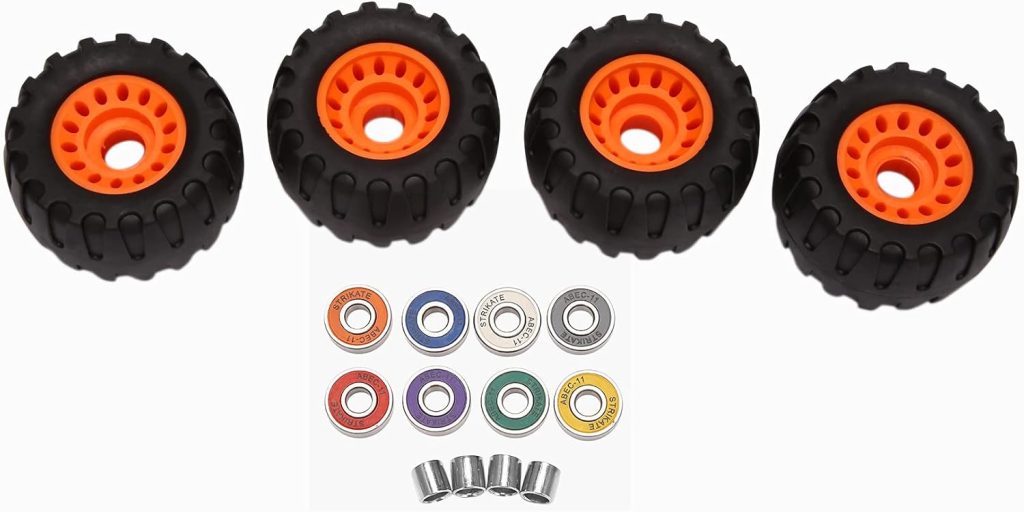
| Treaded urethane | Around 100mm | Packed dirt, grass, broken paths | Heavy and still not pneumatic |
| Pneumatic tire | 150–200mm+ | Dirt trails, gravel and uneven terrain | Requires compatible hubs, axles and substantial clearance |
| Purpose-built mountainboard wheel | Usually 8 inches or larger | Dedicated off-road riding | Not a simple swap onto standard longboard trucks |
1. Large urethane wheels for rough pavement
Large smooth urethane wheels preserve the direct feel of a longboard while rolling more easily over cracks and coarse asphalt. They suit commuting and long-distance pushing, not deep gravel or technical trails. As one current reference, the Orangatang Dad Bod is 105mm in diameter, 62mm wide and available in 77a or 80a. Its size illustrates why clearance must be checked before installation.
A larger diameter increases ride height and leverage at the axle. Acceleration generally feels slower, the setup becomes heavier and wheelbite becomes more likely. Some decks designed around large wheels use brackets, cutouts or unusually low mounting systems; adding the same wheels to a conventional deck may not work.
2. Treaded urethane for occasional dirt
Treaded urethane wheels sit between street wheels and pneumatic tires. The current MBS All-Terrain wheel, for example, is listed at 100mm by 65mm, 78a, and requires 22mm-outside-diameter bearings. MBS states that its one-inch riser kit is required for compatibility with traditional skateboards and longboards.
This type can cross compact dirt, short grass and rough paths more confidently than a normal street wheel. It remains a solid urethane wheel, however, so it cannot deform around rocks and roots like an inflated tire. Grip on loose material is limited by the surface underneath, not just the tread pattern.
3. Pneumatic wheels and mountainboards
Pneumatic tires provide the greatest compliance and traction because the tire and air volume absorb irregularities. They are also larger, heavier and mechanically different. Many products marketed as all-terrain wheels are intended for electric skateboards and depend on specific hubs, pulleys, belts, axle diameters or motor mounts.
For example, current 150mm pneumatic sets commonly specify compatible pulley and belt systems rather than universal longboard fit. A non-powered longboard cannot assume compatibility simply because both products use the word “skateboard.” A purpose-built mountainboard integrates wide trucks, large axles, bindings where appropriate and a deck designed for off-road loads.
Compatibility checklist before buying
- Deck clearance: measure the closest distance between wheel and deck through the full steering range.
- Truck width: wide wheels can contact the deck or place the wheel edge too far inside the rail.
- Axle diameter and length: confirm that the hub, bearings, spacers and axle nut can be installed correctly.
- Bearing dimensions: standard skate bearings are commonly 8mm × 22mm × 7mm, but all-terrain products may use different bearings.
- Core or hub: a street urethane wheel uses a bearing seat; a pneumatic tire may use a separate hub and pulley.
- Riser requirement: enough riser reduces wheelbite but raises the standing platform and changes handling.
- Wheel wells and cutouts: these help clearance but must be checked under actual turning and deck flex.
- Powered-board components: verify pulleys, belts, motor mounts and gearing whenever the board is electric.
Do you need different bearings?
Do not choose bearings by ABEC number alone, and there is no technical basis for a blanket “ABEC-7 or higher” requirement. ABEC describes dimensional tolerances under standardized conditions; it does not measure contamination resistance, impact durability or outdoor rolling speed.
Choose the bearing size required by the wheel or hub. For conventional longboard wheels, use correctly seated skate bearings with appropriate spacers and speed rings. For mountainboard or pneumatic hubs, use the exact dimensions specified by the manufacturer. Seals and regular cleaning matter more off pavement because dust and moisture reach the bearing more easily.
How wheel size changes the setup
Ride height and pushing
A taller wheel raises the axle and usually raises the deck unless the board uses a dropped platform or brackets. A higher platform requires a deeper knee bend while pushing and footbraking, which can increase fatigue.
Wheelbite
Wheelbite occurs when a wheel contacts the deck during a turn or when the deck flexes. It can stop the wheel abruptly. Check clearance with body weight on the board and the trucks turned through their usable range. Do not rely only on a stationary visual check.
Braking and speed control
More mass and momentum can change how quickly the board accelerates or slows. Footbraking on loose ground is unreliable, and sliding a large treaded or pneumatic wheel is not equivalent to sliding a freeride wheel. Learn speed control on a predictable surface before entering mixed terrain.
Truck behavior
Adding large wheels and tall risers changes leverage and the relationship between deck and trucks. Tightening the kingpin excessively to prevent wheelbite can damage bushings and produce poor steering. Correct the geometry and clearance instead.
What terrain can a converted longboard handle?
- Rough pavement and cracks: large smooth urethane is normally sufficient.
- Hard-packed dirt: treaded urethane can work at controlled speed if clearance is adequate.
- Short grass: possible with large treaded wheels, but speed drops quickly and hidden holes are a hazard.
- Loose gravel: traction and steering become unpredictable; pneumatic tires are preferable.
- Roots, rocks and technical trails: use a purpose-built mountainboard and appropriate protective equipment.
- Wet mud: avoid it on improvised longboard conversions; traction, braking and bearing contamination become serious problems.
Setup and inspection
After installation, rotate each wheel and steer fully in both directions. Compress the deck and bushings using realistic rider weight. Confirm that axle nuts retain full thread engagement while allowing the wheels to spin freely. Recheck mounting hardware, axle nuts and wheel clearance after the first short ride.
Pneumatic tires also require pressure checks and inspection for cuts, damaged hubs and loose hardware. Follow the manufacturer’s pressure specification rather than copying a number from an unrelated tire.
Safety for mixed terrain
Wear a certified helmet and protection appropriate to speed and terrain. Begin on flat, open ground without traffic. Walk the route first and look for drainage channels, loose stones, roots, holes and pedestrians. Off-road rolling resistance changes abruptly, so a surface that looks harmless can stop a small wheel immediately.
Do not use traffic hills to test an unfamiliar setup. Standard longboards have no mechanical brake, and footbraking becomes much harder on gravel, grass or uneven dirt.
Which option should you choose?
For rough streets, choose a quality 85–105mm urethane wheel only after checking clearance. For occasional packed dirt, a compatible 100mm treaded urethane wheel can be practical. For real trails or repeated loose terrain, buy or build around a mountainboard platform instead of forcing pneumatic hardware onto ordinary longboard trucks.
Research disclosure
This guide combines Juan Campuzano’s longboarding experience since 2010 with current manufacturer specifications. The referenced wheel systems were researched for dimensions and compatibility; they were not all personally tested by Longboard Bible. Manufacturer claims are treated as product specifications, not independent performance results.