You can ollie many longboards, but the trick is much easier on a board with a functional kicktail. The basic motion is the same as a skateboard ollie—jump, snap the tail, guide the front of the deck upward, level the board and land—but a longboard’s extra length, wheelbase and weight change the timing.
Skill level: intermediate. Be comfortable riding, pushing, turning, kick turning and landing small hops before attempting an ollie. If your board has no usable tail, treat the ollie as an advanced experiment rather than a necessary riding skill.
Is your longboard suitable for ollies?
A clear kicktail is the most important feature. The tail must reach the ground when you press it, creating the pivot that lifts the front of the board. A shorter wheelbase and manageable deck weight generally make the movement easier, while a very long dancer, pintail or low drop-through board demands more timing and effort.
| Board design | Ollie suitability | What to expect |
|---|---|---|
| Compact cruiser with kicktail | Good | Familiar pop and manageable length, though large soft wheels add weight |
| Freestyle longboard with two kicks | Good | Built to support tricks in either direction |
| Dancer with usable kicks | Possible | More deck to lift and slower timing than a compact board |
| Pintail | Difficult | The pointed tail may offer limited pop and little room for the rear foot |
| Drop-through or double-drop without kicks | Poor | No effective tail to snap; use step-offs or another obstacle strategy |
| Downhill board | Not recommended | Usually optimized for stiffness and control rather than ollie mechanics |
If learning ollies is a major goal, a conventional skateboard or freestyle-oriented longboard is a more practical tool than forcing the movement on a low commuter. The longboard tricks guide explains which tricks fit different board designs.
Equipment and practice area
- A board with an intact kicktail, secure trucks and no cracked deck sections.
- A properly fitted skateboard helmet and closed-toe, flat-soled shoes.
- Knee and elbow protection appropriate to your ability and practice environment.
- A flat, dry, traffic-free surface with room to step off safely.
Inspect the area for gravel, cracks and debris. The U.S. Consumer Product Safety Commission recommends protective gear, equipment inspection and practicing away from vehicles; see its skateboarding safety guidance.
How to ollie on a longboard
1. Set your feet
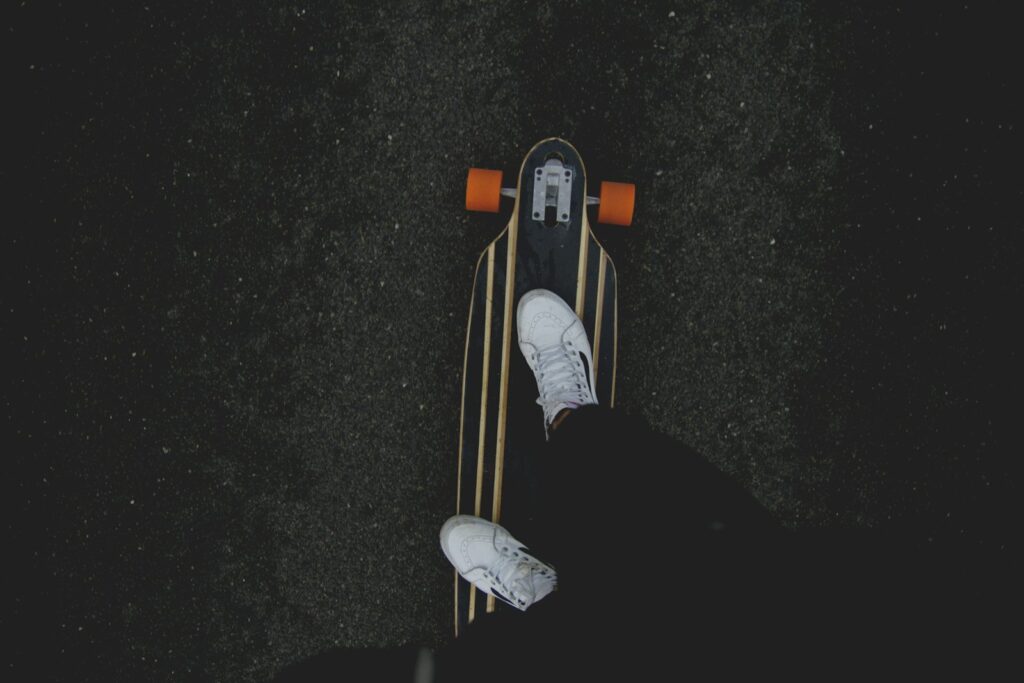
Place the ball of your rear foot on the kicktail so you can snap it without standing on the deck’s edge. Put your front foot around the middle of the standing platform, angled slightly across the deck. Starting closer to the center gives the front foot room to travel, but exact placement depends on deck length and stance.
2. Compress without folding forward
Bend your knees and lower your hips while keeping your balance over the board. Avoid dropping your chest onto the front knee or moving so far toward the tail that the board can roll away. The jump begins from your legs, not from stamping the tail as hard as possible.
3. Jump, then snap the tail
Begin moving your body upward. As your weight leaves the deck, snap the tail toward the pavement with the rear ankle. The rear foot must rise after the snap; if it remains low, it prevents the tail and rear trucks from following the rest of the board into the air.
4. Guide the nose with your front foot
As the nose rises, move the front foot upward and forward along the grip tape. On a longboard, the motion may feel slower and more deliberate than on a street skateboard. The front foot guides the deck; it should not kick completely away from the board.
5. Lift the rear knee and level the board
Bring the rear knee up while the front foot moves toward the nose. Allow the front of the board to travel forward slightly so the rear can rise. This leveling phase is where many longboard attempts fail: the rider creates a strong nose lift but leaves the rear foot and tail low.
6. Stay above the board
Keep your shoulders aligned with the deck and your weight centered between the trucks. Looking generally forward instead of twisting toward your feet helps prevent the board from rotating away from the direction of travel.
7. Land with bent knees
Let the board return to the ground beneath you. Aim to land with both feet over stable areas of the deck and absorb the impact through your knees. Do not force the board down early; bringing your feet down before the deck has leveled can produce a tail-heavy landing.
Break the ollie into smaller drills
- Jump drill: on the stationary board, practice a small vertical jump and land in the same stance without attempting to pop.
- Tail response drill: step off the board and press the tail with one foot to learn how quickly the nose rises. Keep your face and body away from the returning deck.
- Small pop: combine a modest jump and tail snap. The first goal is for all four wheels to leave the ground briefly, not maximum height.
- Leveling drill: focus on lifting the rear knee and guiding the nose forward rather than striking the tail harder.
- Slow rolling ollie: once stationary landings are controlled, add a walking-speed roll on open pavement. A usable ollie must eventually work while moving.
A visual demonstration can clarify the longboard-specific timing. Brandon DesJarlais’s longboard ollie tutorial shows how a longer deck changes the pop-and-level sequence. Use any video as a movement reference, not as a reason to skip protective equipment or progressive practice.
Common ollie problems and fixes
| Problem | What is happening | What to change |
|---|---|---|
| The nose rises but the rear wheels stay down | The rear foot remains low or the board is not being leveled | Lift the rear knee immediately after the snap and guide the nose forward |
| The board shoots ahead | Your body stays behind while the deck moves forward | Jump with your center over the board and reduce the force of the front-foot push |
| The board turns sideways | Your shoulders open or the front foot drags diagonally | Keep shoulders aligned and guide the foot along the deck’s centerline |
| The tail hits but nothing lifts | You are stamping before your body begins to rise | Start the jump first, then snap as your weight leaves the deck |
| You land on the tail | The rear foot comes down early or the deck never levels | Bring both knees up and wait for the board before extending into the landing |
| The motion feels impossibly slow | The board is long, heavy or has a weak kicktail | Use smaller goals or switch to a more suitable trick-oriented board |
When an ollie is the wrong solution
An ollie can help a skilled rider clear a small obstacle, but it should not be the only plan for unpredictable cracks, curbs or debris. Slowing down, stepping off or choosing a clear route is safer than attempting a trick with uncertain timing. On a large commuter board, learning to step off and control the board may be more useful than learning to jump it.
Frequently asked questions
Can you ollie a longboard without a kicktail?
Some highly skilled riders can improvise on decks with minimal tails, but a true ollie is far more difficult without a surface that can strike the ground and lift the nose. For learning, use a board with a functional kicktail.
Is a longboard ollie harder than a skateboard ollie?
Usually. Longboards are commonly longer and heavier, and many have less aggressive kicktails. The movement is recognizable, but the timing is slower and the rider must move more board. A compact cruiser or freestyle longboard reduces that disadvantage.
Should you learn stationary or rolling?
Use stationary drills to understand the sequence, then move to a very slow roll as soon as you can land safely. A stationary-only habit can create body positions that do not transfer cleanly to riding.
Focus on timing, not force
A successful longboard ollie comes from an ordered sequence: rise, snap, guide, lift, level and land. If the board is suitable, practice small controlled pops before chasing height. If the design has no usable kicktail, choose a safer way around obstacles or learn the trick on a board built for it.