
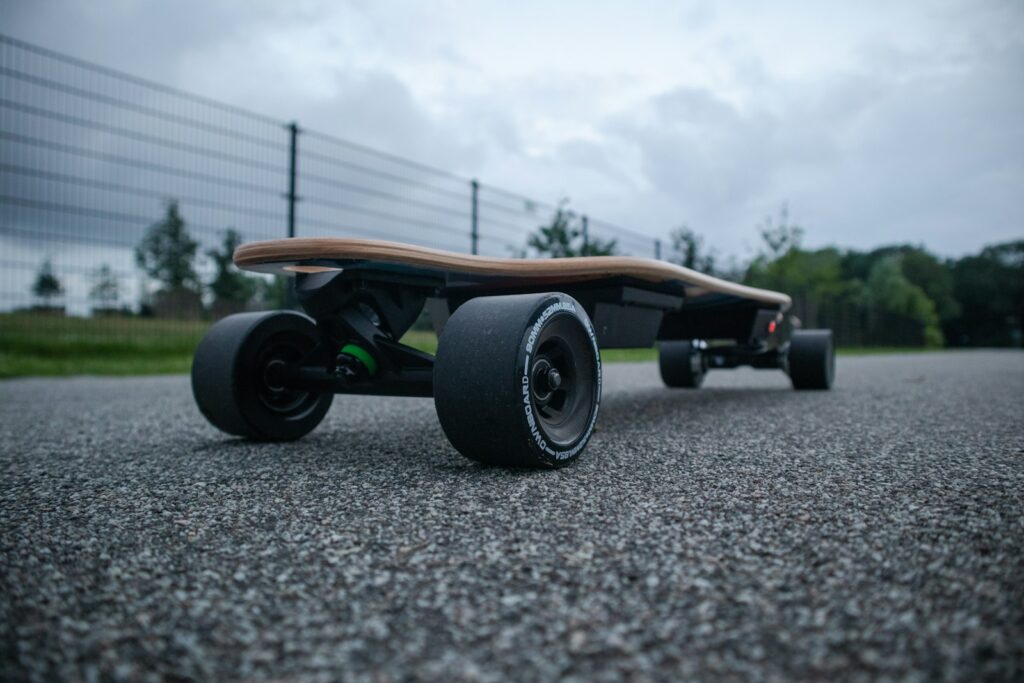
An electric longboard battery must match the board’s controller, motors, charger, enclosure, connectors, and electrical limits as a complete system. Capacity influences potential range, but voltage and current capability determine whether the pack can safely supply the drivetrain. Never choose a replacement by physical size or connector shape alone.
The safest replacement is the exact battery approved by the board manufacturer. If that part is unavailable, use a qualified electric-skateboard or battery professional who can verify every electrical, mechanical, and charging requirement. Building or modifying lithium-ion packs is not a beginner project.
Electric longboard battery specifications
| Specification | What it describes | Why it matters |
|---|---|---|
| Nominal voltage (V) | The pack’s reference operating voltage | Must be compatible with the controller, motors, accessories, and charger architecture |
| Maximum charge voltage | Voltage at full charge for the configured pack | The charger must match it exactly as specified by the manufacturer |
| Capacity (Ah) | Charge stored under defined conditions | Helps calculate energy, but does not predict real range alone |
| Energy (Wh) | Nominal voltage multiplied by amp-hours | Useful for comparing pack energy and checking transport rules |
| Continuous current | Current the complete pack can deliver continuously within its design limits | Must support the drivetrain without overheating or protective cutoffs |
| Peak current | Short-duration capability under stated conditions | Not a substitute for an adequate continuous rating |
| Cell configuration | Cells connected in series and parallel | Series affects voltage; parallel affects capacity and current sharing |
| BMS | Battery management system | Monitors and protects the pack within its designed functions and limits |
| Connector and polarity | Electrical interface and positive/negative orientation | A matching plug does not prove correct voltage, polarity, or pin function |
Voltage, amp-hours, and watt-hours
Voltage is related to the pack’s series configuration and the operating range expected by the electronic speed controller (ESC). Amp-hours describe charge capacity. Watt-hours provide a convenient nominal energy figure:
Nominal watt-hours = nominal volts × amp-hours
For example, a pack labeled 36 V nominal and 10 Ah has a nominal energy rating of 360 Wh. That arithmetic does not establish usable energy, current capability, range, cell quality, or compatibility. Use the manufacturer’s documented rating when one is supplied.
What series and parallel labels mean
Pack descriptions often use an “S” and “P” format. Cells in series raise pack voltage; cells in parallel add capacity and share current. A 10S4P description therefore indicates ten series groups with four cells in each parallel group. It does not tell you whether the cells, interconnects, BMS, enclosure, and assembly quality are appropriate for a particular board.
Do not change series count to pursue more speed. Higher voltage can exceed controller, motor, capacitor, charger, display, or accessory limits. It can also change braking behavior and stress. Only use a configuration explicitly supported by the complete system.
The BMS is important—but not a complete safety guarantee
A battery management system may monitor cell groups and provide protections related to charging, discharging, current, temperature, or voltage, depending on its design. Its presence does not make an unknown or mismatched pack safe. Protection thresholds, sensor placement, balancing strategy, current rating, wiring, and integration all matter.
UL Solutions explains that UL 2272 evaluates the electrical system of personal e-mobility devices, including e-skateboards, while UL 2271 addresses batteries for light electric vehicle applications. A claim about one cell or component is not the same as certification of the battery pack or complete board. Verify certification in the certifier’s directory rather than relying only on a marketplace badge.
How much range will a battery provide?
No fixed miles-per-watt-hour figure works for every electric longboard. Real range changes with rider and cargo weight, speed, acceleration, hills, wind, surface, wheel type and pressure where applicable, drivetrain, temperature, battery age, voltage sag, riding mode, and how the manufacturer defines an empty battery.
- Compare boards using watt-hours and a documented test method, not a range claim alone.
- Treat manufacturer range as condition-dependent.
- Plan a reserve rather than riding until power disappears.
- Expect cold conditions, hills, high speed, repeated acceleration, and large or pneumatic wheels to alter consumption.
- Evaluate battery health if range drops suddenly instead of assuming normal aging.
Regenerative braking does not guarantee that every descent will add usable range. Charging acceptance depends on pack state and system design; a fully charged battery may have limited ability to accept regenerated energy. Follow the manufacturer’s guidance before beginning a long descent at full charge.
Replacement battery compatibility checklist
- Identify the exact board revision. Model names can span different electronics and battery versions.
- Obtain the official battery part number. Prefer the manufacturer-approved pack.
- Match electrical limits. Confirm nominal and maximum voltage, current requirements, BMS behavior, charger specification, communication wiring, and accessory outputs.
- Verify every connector. Check type, pinout, polarity, wire gauge, and current rating. Never infer polarity from wire color alone.
- Verify mechanical fit. Confirm dimensions, mounting points, cable routing, strain relief, gasket, and deck-flex allowance.
- Confirm thermal and environmental design. The enclosure must not trap the wrong amount of heat or compromise the board’s original sealing.
- Check software pairing. Some systems expect battery data or firmware compatibility.
- Use the specified charger. Similar plugs do not make chargers interchangeable.
If any item is undocumented, stop and contact the board maker or a qualified service provider. A battery listing that states only voltage and capacity is insufficient for a responsible replacement decision.
Charging safety
The U.S. Consumer Product Safety Commission advises users to be present while charging micromobility products, never charge while sleeping, use the supplied charger, use an approved replacement battery, follow manufacturer instructions, and unplug when charging is complete. It also warns against unapproved “universal” chargers because batteries have specific charging requirements. See the CPSC’s micromobility charging guidance and universal-charger warning.
- Charge in a dry area on a stable, noncombustible surface with clear space around the board.
- Keep the board and charger away from exits and escape routes.
- Do not cover the charger or battery during charging.
- Do not charge a wet, swollen, punctured, crashed, unusually hot, leaking, or modified pack.
- Keep children and pets away from charging equipment.
- Stop using the system if it develops unusual heat, odor, smoke, hissing, discoloration, or deformation.
- Do not open or attempt to extinguish a battery incident without following local emergency guidance; move away and call emergency services when there is fire, smoke, or immediate danger.
Water, impact, and heat
A water-resistance claim is not permission to submerge the board, pressure-wash it, or charge it while wet. Seals age, fasteners loosen, and impacts can damage an enclosure. After water exposure, follow the manufacturer’s instructions; do not open or energize a suspect pack simply to “check whether it works.”
Inspect the enclosure and deck after curb strikes, crashes, bottom-outs, or hard landings. A battery can be damaged without obvious cell exposure. Do not leave the board in a hot vehicle or near a heater, and stay within the maker’s charging, riding, and storage temperature limits.
Storage and long periods without riding
Follow the board manufacturer’s storage-charge and inspection schedule because lithium chemistries and battery-management behavior vary. Store the board in a cool, dry location away from combustible materials, direct sun, heat sources, exits, and physical damage. Do not leave it connected to the charger indefinitely unless the manufacturer explicitly designs and instructs the system for that use.
Check a stored battery at the interval specified by the manufacturer. If a pack becomes deeply discharged, do not attempt improvised recovery or use a charger with a different specification.
Can you fly with an electric longboard battery?
Do not assume an electric longboard is permitted because its battery is removable. Airline policies, battery energy, installed versus spare status, destination rules, and dangerous-goods requirements all matter. The FAA states that spare lithium-ion batteries are prohibited in checked baggage and directs passengers to its current lithium-battery baggage guidance. Airlines may impose additional restrictions or refuse powered boards.
Check the current FAA or relevant national authority rules and obtain confirmation from the operating airline before travel. Keep the original label showing watt-hours and model information. For the broader packing decision, use the longboard air-travel guide.
Disposal and recycling
Do not place an electric longboard battery in household trash or general recycling. The CPSC directs consumers to a local battery recycler or hazardous-waste collection center. Before transport, ask the facility how it accepts damaged versus undamaged lithium batteries; special handling may be required. Do not ship a damaged battery unless a qualified carrier and applicable dangerous-goods rules explicitly allow and package it.
Common battery problems
| Symptom | Possible categories | Safe response |
|---|---|---|
| Sudden range loss | Temperature, tire or wheel change, riding conditions, imbalance, aging, or fault | Stop demanding use and follow manufacturer diagnostics |
| Power cuts under acceleration | Protection event, voltage sag, connection, controller, or battery fault | Do not continue riding in traffic or at speed; obtain service |
| Will not charge | Charger, port, temperature, BMS, wiring, or cell fault | Do not substitute chargers or bypass protection |
| Swelling, odor, smoke, hissing, or unusual heat | Potential battery failure | Move away, keep others clear, and contact emergency services if danger is present |
| Corrosion or water inside enclosure | Seal failure or water ingress | Do not charge or ride; isolate safely and contact qualified service |
Frequently asked questions
Can I install a larger-capacity battery?
Only when the board manufacturer or a qualified system designer verifies electrical limits, current capability, charger, BMS, connectors, communication, enclosure, mounting, flex, thermal behavior, and software compatibility. More watt-hours alone does not establish a safe upgrade.
Can I use a charger with the same connector?
No—not without explicit manufacturer approval for that board and battery. Connector fit does not confirm correct voltage, polarity, current profile, or communication. The CPSC specifically warns against unapproved universal micromobility chargers.
How long does an electric longboard battery last?
There is no responsible universal lifespan. Cell chemistry, temperature, charge level, discharge demand, storage, vibration, water exposure, manufacturing quality, and protection strategy all affect aging. Use the maker’s warranty and capacity-retention terms when comparing products.
Bottom line
Treat the electric longboard battery, BMS, charger, controller, enclosure, and wiring as one safety-critical system. Prefer an approved replacement, verify current third-party certification where claimed, charge only as instructed while present, and stop using any damaged or abnormal pack. Capacity matters only after compatibility and safety are established.