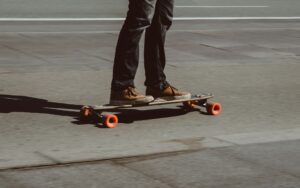
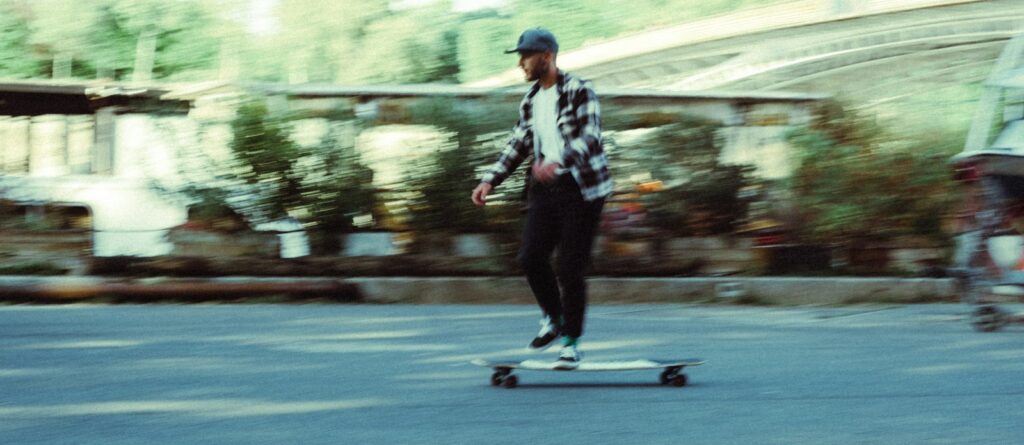
Freestyle longboarding is the trick-focused side of longboarding: manuals, pivots, shuvits, no-comply variations, ollies and combinations performed mainly on flat or gently sloped terrain. It overlaps with dancing, but freestyle gives more importance to manipulating the board rather than moving continuously across a long platform.
Skill level: beginner to advanced. Riders can begin with stationary balance drills and basic pivots after learning to ride and stop. Popped, flipped and airborne tricks require progressive practice and a suitable board.
Freestyle vs dancing and freeride
| Discipline | Primary focus | Typical environment |
|---|---|---|
| Freestyle | Manuals, pivots, spins, shuvits, ollies and combinations | Flat, smooth open pavement or suitable skate areas |
| Dancing | Cross-steps and flowing footwork across the deck | Long, smooth paths with room for continuous motion |
| Freeride | Slides and creative speed control on descents | Controlled slopes with runoff |
Freestyle longboard setup
Deck and kicktails
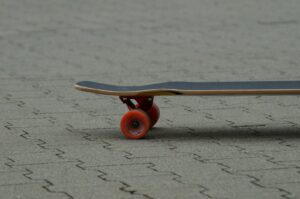
A freestyle deck benefits from usable kicks at both ends, a predictable shape in either direction and enough standing room for landing. A shorter, lighter deck is generally easier to move than a pure dancer, while a longer platform provides more room for footwork. Hybrid dancing/freestyle decks balance those priorities.
Flex and construction
Some flex can add comfort, but excessive movement can make pop and landings inconsistent. The correct flex depends on construction, wheelbase and rider weight. Follow the exact manufacturer’s guidance and inspect the deck regularly for impact damage or cracks.
Trucks, bushings and wheels
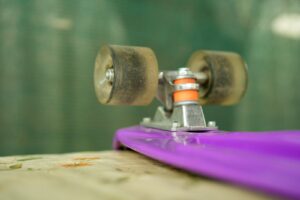
The setup should turn predictably and remain supportive during takeoff and landing. Truck width should suit the deck, and wheel clearance must be checked through the full lean. Smaller or lighter wheels may make tricks easier to initiate, while larger wheels roll over rough pavement more easily. There is no universal freestyle wheel specification.
Skills to build first
- Stable riding and braking: control the board before adding tricks.
- Kick turns and pivots: learn to unweight one end and rotate without jumping.
- Manuals: balance briefly on one truck while keeping the tail from dragging excessively.
- Step-off and no-comply movements: learn how to leave and rejoin the deck in control.
- Shuvits: rotate the board beneath a controlled jump after pivots are reliable.
- Ollies: add popped jumps only on a board with a functional kicktail and after safe landing mechanics are consistent.
The dedicated ollie article is currently a draft and should be linked here only after publication. The existing longboard tricks guide provides a broader overview of what different boards can do.
How to practice progressively
- Learn one movement at a time before connecting a line.
- Start with low-amplitude attempts and controlled step-offs.
- Practice regular and switch stance to avoid one-sided control.
- Film occasional attempts from a safe position to check posture and landing, not to encourage larger risks.
- Stop when fatigue causes stiff landings, missed foot placement or reduced awareness.
What a controlled landing looks like
Both feet return to stable parts of the platform, the board stays beneath the rider and the knees absorb impact without collapsing inward or locking. The rider can continue rolling or step off deliberately. A trick is not complete when the board is caught but control is immediately lost.
Common mistakes
- Choosing a board without useful kicks: equipment cannot create pop where the deck provides no tail leverage.
- Attempting full tricks before learning their parts: practice balance, rotation and landing separately.
- Looking down through the entire movement: brief visual checks are useful, but constant downward focus harms alignment and awareness.
- Landing with straight legs: absorb impact through a centered, bent-knee stance.
- Practicing near traffic or pedestrians: a missed board can travel farther than expected.
Safety and board inspection
Wear a properly fitted skateboard helmet and protection suited to the trick and environment. Use a dry, clean, traffic-free area with enough space for the rider and an escaped board. Check the deck—especially around kicks and mounting holes—plus hardware, trucks and wheels before practice.
See Longboard Bible’s protective gear guide and the U.S. Consumer Product Safety Commission’s skateboarding safety guidance.
Frequently asked questions
Can you freestyle on any longboard?
Basic pivots and manuals are possible on many boards, but tricks that depend on pop require functional kicktails. Very long, heavy or low decks make airborne tricks substantially harder.
Is freestyle longboarding beginner-friendly?
The entry-level skills can be. Start with balance, pivots and small manuals after basic riding is secure. Ollies, flips and complex combinations are not beginner fundamentals.
Do freestyle longboards work for cruising?
Many do, especially hybrid setups. They may be less efficient than a low commuter and less spacious than a dedicated dancer, but can offer a useful balance of transportation and tricks.
Build a vocabulary of controlled movements
Freestyle progression comes from reliable fundamentals, not from forcing the hardest trick available. Learn balance and pivots, add controlled board rotation, then develop popped tricks on suitable equipment. A clean ride-away is part of every successful trick.