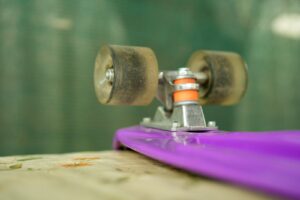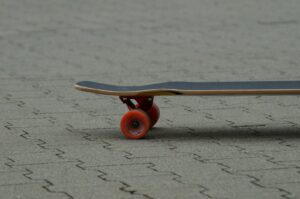

Yes, a kicktail cruiser can do real tricks. The most useful progression is tic-tacs, kickturns, manuals, pivots, hippie jumps, shove-its and ollies. A compact cruiser behaves differently from both a street skateboard and a long dancing deck, so choose tricks that match its tail, nose, wheelbase and wheels.
This guide focuses specifically on compact cruiser boards with a functional kicktail. For a broader explanation covering dancing, freestyle and sliding disciplines, read Can You Do Tricks on a Longboard?.
Before learning tricks
You should be able to push, coast, turn and footbrake without looking down continuously. Practice on clean, flat pavement away from traffic. Wear a certified helmet; wrist guards and knee/elbow pads are sensible while learning falls and jumps.
- Check the deck for cracks and delamination.
- Tighten mounting hardware and verify that axle nuts retain the wheels without preventing them from spinning.
- Confirm full turning clearance so the wheels cannot contact the deck.
- Remove stones, water and loose debris from the practice area.
- Learn how to step or run off the board at walking speed before attempting pop tricks.
What makes a cruiser suitable for tricks?
A functional kicktail
A kicktail gives the rear foot leverage to lift or rotate the board. A short decorative tail may manage curb lifts but provide too little platform for consistent ollies. A wider, steeper tail generally offers clearer foot placement, although it can require more effort to pop.
Manageable wheelbase
A compact wheelbase makes pivots and rotations easier. Longer wheelbases feel calmer while cruising but increase swing weight. Current hybrid cruisers illustrate this design: boards such as the Landyachtz ATV and Loaded Coyote combine compact dimensions, functional tails and soft wheels to support cruising and street-style tricks.
Wheels that match the goal
Large soft wheels roll comfortably over rough pavement but are heavier and grip more strongly during slides. Smaller or slightly harder cruiser wheels reduce weight and may release more predictably, but they transmit more vibration. Do not change wheels without checking wheelbite and riser requirements.
Grip and concave
Grip tape must secure the feet without making repositioning impossible. Mild concave can provide orientation; excessive concave may make flip tricks awkward. Replace contaminated or peeling grip before practicing jumps.
Beginner cruiser-trick progression
1. Tic-tacs
Tic-tacs move the board by alternating small kickturns. They teach tail pressure, front-wheel lift and shoulder timing.
- Place the back foot over the tail and the front foot near or just behind the front bolts.
- Bend the knees and apply only enough tail pressure to lighten the front wheels.
- Rotate the shoulders a few degrees and let the board follow.
- Set the front wheels down, then repeat to the opposite side.
- Keep each movement small until you can generate forward motion without pushing.
2. Stationary kickturn
A kickturn rotates the board around the rear wheels. Start with 20–45 degrees rather than attempting 180 immediately.
- Stand over the trucks with knees bent.
- Shift controlled pressure to the tail without leaning the torso behind the rear axle.
- Turn the head and shoulders toward the new direction.
- Guide the front of the board with the front foot.
- Set the front wheels down softly and recenter your weight.
3. Manual
A manual balances on the rear wheels while the board rolls. It is a balance drill, not a contest to lean as far back as possible.
- Roll at walking speed on flat ground.
- Keep the back foot over the rear axle or tail pocket and the front foot near the front bolts.
- Lower the hips and shift pressure gradually rearward.
- Use the front foot and arms for small corrections.
- End the manual by lowering the front wheels rather than stepping off backward.
Practice over a marked distance of one board length. Extend the distance only when you can enter and exit in control.
4. Pivot
A pivot combines a brief manual with rotation. A frontside or backside 180 pivot finishes in switch stance.
- Practice riding switch before attempting a full 180.
- Initiate a small manual.
- Turn the head and shoulders while keeping the body centered above the rear truck.
- Guide the deck through the rotation instead of throwing it.
- Lower the front wheels and absorb the landing with bent knees.
5. Hippie jump
A hippie jump teaches jumping while the board continues rolling, without requiring tail pop.
- Roll slowly with both feet over the bolts.
- Compress evenly without leaning forward or backward.
- Jump straight upward and keep shoulders aligned with the deck.
- Let the board roll beneath you.
- Land over the bolts with knees bent.
Start with a jump only a few centimeters high. Do not introduce an obstacle until takeoff and landing are repeatable.
6. Shove-it
A shove-it rotates the board 180 degrees beneath the rider. On a directional cruiser, the large tail and small nose make switch position feel different.
- Practice the scooping motion on a surface where the board cannot roll freely.
- Place the back foot on the tail edge and the front foot near the middle/front bolts.
- Scoop the tail backward while jumping vertically.
- Keep the torso facing forward and allow the board to rotate beneath you.
- Catch the deck over the bolts and land with bent knees.
Avoid stomping the tail excessively. The aim is a controlled horizontal rotation, not maximum height.
7. Ollie
The ollie requires coordinated tail pop, jump and front-foot guidance. Soft wheels and a heavy cruiser can make it feel slower than on a street skateboard.
- Set the back foot on the tail and the front foot around the middle of the board.
- Compress with shoulders centered above the deck.
- Pop the tail and jump upward; do not jump backward.
- Guide the front foot toward the nose to level the board.
- Bring both knees up, then land over the trucks and absorb the impact.
First practice the pop and jump without trying for height. Tail wear is normal, but repeated practice on rough concrete can shorten the deck’s life.
What about powerslides?
A powerslide is both a trick and a speed-control technique, but it should not be the first skill on this list. It requires reliable carving, weight transfer, speed judgment and an open practice area. Soft cruiser wheels can slide, but usually require more force and may reconnect abruptly.
Learn speed control first through footbraking. Use protective equipment and begin with a qualified instructor or an experienced rider in a controlled location. Manufacturer tutorials such as Landyachtz’s current cruiser trick and slide resources can provide visual reference, but a video cannot assess your surface, traffic or technique.
Tricks that do not fit every cruiser
- Nose manuals and nollies: difficult or impractical when the nose is flat or extremely short.
- Flip tricks: possible on some cruisers, but wide heavy decks and soft wheels require more effort.
- Longboard dancing: compact cruisers lack the standing platform used for cross-steps and spins.
- High-speed slides: require freeride skills, appropriate wheels and substantially more safety preparation.
- Grinding: large soft wheels and wide trucks may interfere with obstacles; street setups are normally better suited.
How to structure a practice session
- Warm up with pushing, carving and footbraking.
- Choose one trick and one small measurable goal.
- Alternate attempts with controlled cruising so fatigue does not destroy technique.
- Film from a safe position to check shoulder alignment and foot placement.
- Stop when landings become uncontrolled or the practice area becomes busy.
- Inspect hardware and deck damage after repeated pop practice.
Common mistakes
- Looking at the feet throughout the entire trick.
- Trying to rotate the board only with the legs while the shoulders remain fixed.
- Leaning behind the tail instead of staying centered above the truck.
- Landing between the trucks with locked knees.
- Attempting tricks on hills before mastering them on flat ground.
- Tightening trucks excessively to hide balance problems.
- Copying a street-skateboard technique without accounting for a cruiser’s wheel weight and directional shape.
Which cruiser tricks should you learn first?
Start with tic-tacs, kickturns and short manuals. Add pivots and hippie jumps once you can recenter the board consistently. Learn shove-its and ollies only after tail control and safe landings feel routine. Leave powerslides and fast variations until braking, switch riding and surface judgment are dependable.
Research disclosure
This tutorial combines Juan Campuzano’s longboarding experience since 2010 with current cruiser-trick resources from specialist manufacturers. The referenced products illustrate suitable geometry; they were not all personally tested by Longboard Bible.