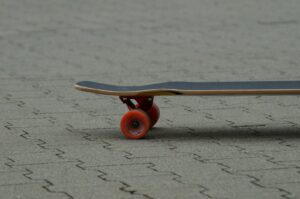

A longboard is a type of skateboard designed around rolling, turning and stability over distance rather than one fixed length. Longboards commonly use wider or longer wheelbases, larger softer wheels and shapes suited to cruising, carving, commuting, downhill, freeride, dancing or long-distance riding. Some are shorter than boards sold as “cruisers,” so length alone does not define the category.
The term describes a family of setups rather than a single standard. Even competition rules define equipment for a specific discipline instead of declaring one universal minimum length. For example, the current World Skate downhill rulebook sets maximum dimensions and safety requirements for competition boards, not a general consumer definition of “longboard.”
Longboard vs skateboard
| Feature | Typical longboard | Typical street skateboard |
|---|---|---|
| Primary use | Cruising, carving, distance, downhill, dancing | Street tricks, skateparks, transitions |
| Wheelbase | Usually longer, with many discipline-specific variations | Usually compact for pop and rotation |
| Wheels | Often larger and softer for grip and rough pavement | Usually smaller and harder for tricks and smooth surfaces |
| Trucks | Often wider; reverse-kingpin trucks are common | Traditional-kingpin trucks are standard |
| Deck | May be top-mount, drop-through, drop-down or double-drop | Usually a kicktailed popsicle shape |
These are tendencies, not absolute rules. Hybrid cruisers can use skateboard-style trucks and kicktails with soft wheels. Freestyle longboards can perform ollies and shove-its. A street skateboard can cruise if fitted with suitable wheels. The real difference is how the entire setup is optimized.
For a direct buying comparison, see Skateboard vs Longboard.
The parts of a longboard
Deck
The deck is the platform under the rider. Its length, width, wheelbase, mounting style, concave, flex and construction influence stance, leverage and clearance. Maple is common; bamboo, fiberglass, carbon fiber and other composites can change flex, weight and durability. Material alone does not determine whether a deck is good.
Trucks
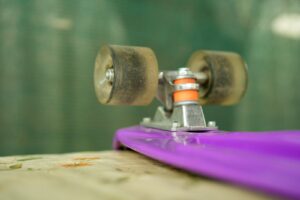
Trucks connect the wheels to the deck and turn when the rider leans. Reverse-kingpin trucks are common on longboards because their geometry can provide predictable carving and a broad tuning range. Traditional-kingpin trucks are common on compact cruisers, freestyle setups and extremely low double-drop commuters. Width and baseplate angle must suit the deck and discipline.
Bushings
Bushings are urethane components inside the trucks that resist steering movement. Their shape, hardness, seat and compression influence how easily the board turns and returns to center. Rider weight and intended speed matter more than choosing the hardest or softest option available.
Wheels
Longboard wheels are commonly larger and softer than street-skateboard wheels. Diameter influences clearance, acceleration and the ability to roll over rough pavement. Urethane formula, hardness, width, contact patch, lip shape and core position affect grip and sliding behavior. Read Longboard Wheels Explained before mixing components.
Bearings, spacers and hardware
Bearings allow each wheel to rotate on the axle. A higher ABEC number does not automatically make a longboard faster; outdoor speed also depends on wheel quality, lubrication, contamination, load and installation. Bearing spacers and speed rings help maintain alignment where the setup is designed to use them. Mounting hardware must remain secure without crushing the deck.
The main types of longboard
Cruising and carving
Cruising boards prioritize comfortable rolling and intuitive turning. They range from portable mini cruisers to flexible drop-through decks. Carving describes repeated turns across the direction of travel; the setup should turn progressively and retain adequate wheel clearance.
Commuting and distance
Distance boards reduce fatigue through efficient geometry, low ride height and wheels suited to the route. Drop-down, double-drop and bracket designs can place the deck close to the ground. Compact dimensions can still provide a long functional wheelbase, so a distance board does not need to look exceptionally long.
Downhill
Downhill boards are built for control at speed. Modern designs are often stiff, relatively compact and top-mounted for leverage, with defined concave and wheel flares. The board alone does not make downhill safe: technique, protective equipment, road inspection and speed management are essential.
Freeride
Freeride focuses on controlled sliding and technical descending. Decks usually provide secure foot reference, suitable stiffness and predictable leverage. Wheels are selected for a balance of grip, release and wear rather than maximum softness.
Dancing and freestyle
Dancing decks provide a spacious platform for cross-steps, spins and other footwork. Freestyle adds manuals, pivots, shove-its and aerial tricks, so functional kicktails and manageable swing weight matter. Current manufacturer lineups treat dancing/freestyle as a distinct category alongside distance, carving and downhill, illustrating how broad “longboard” has become.
Surfskate
Surfskates use specialized front-truck geometry to generate deep turning and pumping. They overlap with longboarding but have a distinct steering feel and setup logic. A surfskate is not automatically the easiest first longboard because its front end can feel unusually responsive.
Electric longboard
An electric longboard adds motors, battery, electronics and a braking system. Wheel, truck and deck compatibility differ from an unpowered board, and local vehicle rules may apply. Advice for a conventional longboard should not be assumed to cover powered setups.
Common deck mounting styles
- Top-mount: trucks attach beneath the deck. This provides direct leverage and is common in downhill, freeride and compact cruising.
- Drop-through: truck baseplates pass through cutouts in the deck, lowering the standing platform. See What Is a Drop-Through Longboard?
- Drop-down: the deck itself bends or is molded lower between the trucks. See our Drop-Down Longboard Guide.
- Double-drop: combines a dropped platform with drop-through or bracket-style mounting for a very low ride. See the Double-Drop Guide.
How a longboard turns
A rider turns by shifting pressure through the deck into the trucks. The truck hangers rotate relative to their baseplates as the bushings compress. Baseplate angle, truck design, wheelbase, bushing setup and rider input determine how quickly and deeply the board turns.
Tightening the kingpin is not a universal solution for stability. Excessive compression can damage bushings and make steering inconsistent. Stability should come from appropriate geometry, component alignment, speed-appropriate technique and a setup matched to the rider.
Is a longboard easier for beginners?
A suitable longboard can feel easier to stand on because it may offer a wider platform, longer wheelbase and softer wheels. That does not make every longboard beginner-friendly. A tall top-mount, highly responsive surfskate or specialized downhill setup can be difficult for a new rider.
A first board should provide predictable steering, enough standing room, wheels suitable for local pavement and a ride height that allows comfortable pushing and footbraking. Start with How to Choose a Longboard or compare our researched beginner longboards.
What can you do on a longboard?
- Commute or travel on paved paths.
- Carve on flat or gently sloped terrain.
- Practice long-distance pushing and pumping.
- Learn dancing and freestyle footwork.
- Perform controlled freeride slides after developing braking skills.
- Ride downhill only with advanced training, appropriate protection and a controlled environment.
Longboards are not intended to make every surface safe. Small wheels can still stop at holes, stones and debris. Wet pavement reduces traction, and traffic introduces hazards that equipment cannot remove.
Basic safety
Wear a certified helmet and protection appropriate to your discipline. Inspect the deck, mounting hardware, trucks, bushings, axle nuts and wheels before riding. Learn to push, turn and stop on flat ground before adding hills. Our beginner sequence covers stance, turning and stopping.
How much does a longboard cost?
Entry-level completes can cost below $100, while quality specialist and discipline-specific setups commonly cost several hundred dollars. Price should follow the intended use and component quality, not branding or an ABEC claim. See the current Longboard Price Guide.
The most useful definition
A longboard is best understood as a skateboard setup whose deck, wheelbase, trucks and wheels are configured primarily for rolling and turning performance across one or more longboarding disciplines. It may be long, but its geometry and purpose define it more accurately than a tape measure.
Research disclosure
This guide combines Juan Campuzano’s longboarding experience since 2010 with current discipline definitions and manufacturer setup categories. External sources describe their own equipment; they are used as technical references, not independent product endorsements.