
To choose a longboard, start with how and where you will ride—not the graphic, brand or bearing rating. Your terrain and intended riding style determine the useful deck height, wheelbase, stiffness, trucks and wheels.
This guide explains the decision in order. It does not recommend specific products; for current model comparisons, see the beginner longboard comparison.
Choose your riding goal first
| Main goal | Useful starting characteristics | Main compromise |
|---|---|---|
| Cruising | Stable platform, soft wheels, predictable trucks | Full-size boards are less portable |
| Commuting | Low deck, efficient pushing, larger wheels | Very low decks can scrape on obstacles |
| Carving and pumping | Responsive trucks, suitable flex, wheel clearance | Flexible setups are not designed for speed |
| Dancing and freestyle | Long standing platform, usable nose and tail, controlled flex | Extra length and weight |
| Freeride | Secure concave, predictable slide wheels, appropriate stiffness | Less forgiving for a complete beginner |
| Downhill | Stiff, purpose-built setup and advanced safety equipment | Not a suitable first discipline without instruction |
If you are completely new and do not yet have a specialty, prioritize flat-ground cruising, reliable turning and easy foot braking. Do not buy a downhill setup simply because it appears stable.
Step 1: match the deck height to the terrain
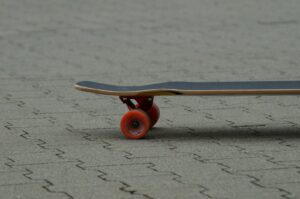
Deck height is one of the most noticeable differences between longboards. A lower standing platform reduces how far your pushing foot must travel to the ground. This can make repeated pushes and foot braking easier.
Top-mount
The deck sits directly on top of the trucks. Top-mounts provide leverage and responsive turning, making them useful for carving, freeride and some cruising setups. The taller platform requires more balance while pushing.
Drop-through
The trucks pass through cutouts in the deck. This lowers the platform while retaining a relatively simple deck shape. Drop-throughs are common for cruising and commuting, although the reduced leverage can feel less lively than a comparable top-mount.
Drop deck and double drop
A drop deck lowers the standing area between the trucks. A double drop combines a dropped platform with drop-through mounting. These designs can be efficient for distance and braking, but low ground clearance can be a problem around curbs, speed bumps and severe road transitions.
Compare the designs in drop-through vs drop-down longboards.
Step 2: choose a usable size, not the biggest number
Overall deck length alone does not determine stability. Wheelbase—the distance between the truck mounting positions—has a major effect on how quickly a board turns. Width, standing platform and truck geometry also matter.
- Compact boards around 28–34 inches: easier to carry and maneuver, but usually provide less standing room and a shorter wheelbase.
- Medium boards around 34–40 inches: a common range for cruising, carving and general use.
- Long boards above 40 inches: can provide space for dancing or a long wheelbase, but become inconvenient to transport.
Use these as broad categories rather than fixed rules. A compact double-drop commuter and a 32-inch top-mount cruiser can behave very differently despite similar length. See the longboard size guide for a more detailed comparison.
Step 3: understand directional and symmetrical shapes
A directional deck is intended to have a front and rear. It can be useful when the truck positions, taper or concave are optimized for forward riding. A symmetrical deck has matching ends and is convenient for riding switch, freestyle and freeride.
A pintail’s tapered ends reduce the chance of wheel contact and create a traditional cruising appearance, but the taper also removes usable standing area near the wheels. Read the pintail guide before choosing one only for its shape.
Step 4: match flex and concave to rider weight
Flex descriptions are not standardized across brands. The same “medium” label can feel different depending on deck length, construction and rider weight.
- Flexible decks: absorb some vibration and feel lively while carving, but can oscillate or bottom out when overloaded.
- Moderate flex: often suits low-speed cruising and carving when matched to the rider.
- Stiff decks: respond directly and are necessary for speed-oriented disciplines, but may transmit more road vibration.
Concave describes how the deck curves across its width. Mild radial concave can help locate the feet without creating pressure points. Stronger concave, wheel flares and W-shaped features can increase foot support for freeride or downhill, but may be uncomfortable for relaxed cruising.
Use the manufacturer’s rider-weight range when available. Do not assume bamboo is always flexible or maple is always stiff: construction, thickness and geometry determine the final behavior.
Step 5: choose the correct trucks
Most full-size longboards use reverse-kingpin trucks because they provide smooth, adjustable steering. Traditional-kingpin trucks are common on compact cruisers and some low commuter designs.
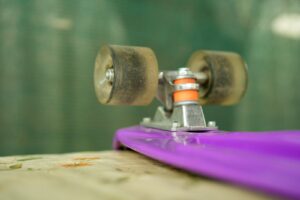
Truck width should be compatible with the deck width. Wheels that extend far outside the deck can be kicked while pushing; trucks that are too narrow can create clearance or leverage problems. Common 150 mm and 180 mm measurements are useful references, not universal prescriptions.
Baseplate angle influences steering. Higher angles generally turn more for a given lean, while lower angles generally turn less and can feel more stable. Truck design, bushings and wheelbase affect the result, so angle should never be evaluated alone.
For a deeper explanation, use the longboard trucks guide.
Step 6: choose wheels for the actual pavement
For ordinary cruising, soft polyurethane wheels are usually more comfortable and predictable than small, hard skateboard wheels. Three measurements matter:
- Diameter: larger wheels roll over cracks more easily and maintain momentum, but require enough deck clearance.
- Durometer: lower numbers generally indicate softer wheels. Approximately 78A–83A is a useful cruising starting range, not a guarantee of quality.
- Shape and contact patch: square lips and wider contact patches tend to emphasize grip; rounded lips and narrower contact patches generally release into a slide more easily.
Urethane formula matters as much as the printed hardness. Check for wheelbite by leaning the board fully with your normal stance before riding. Wheel wells, cutouts or risers may be required when using larger wheels.
See longboard wheel size, hardness and fit.
Step 7: do not choose bearings by ABEC alone
ABEC is an industrial tolerance classification. It does not directly measure longboard speed, durability, sealing, lubrication, spacer fit or resistance to dirt and water. A larger ABEC number does not automatically create a faster board on real pavement.
Choose bearings from a reputable manufacturer, install the correct spacers when the setup is designed for them and tighten the axle nuts without binding the wheels. Maintenance and wheel quality often matter more than the printed rating.
Step 8: budget for safety and adjustment
The purchase price should include a certified helmet and protection appropriate to your riding. You may also need bushings matched to your body weight, a skate tool or replacement wheels for local pavement.
A premium complete is poor value if it is the wrong discipline. A used board from a reputable manufacturer may be better than a new mystery-brand complete, but inspect the deck for cracks, delamination and water damage. Check axle threads, truck alignment and wheel clearance.
Use the longboard cost guide to estimate the complete budget.
A practical decision sequence
- Write down your primary use: cruising, commuting, carving, dancing or another discipline.
- Describe the terrain: smooth path, rough street, hills, tight urban turns or mixed surfaces.
- Choose deck height based on pushing efficiency and desired leverage.
- Select a wheelbase and standing platform that provide enough room without becoming impractical to carry.
- Confirm the flex or stiffness is appropriate for your body weight.
- Check truck width, wheel diameter and wheelbite clearance as one system.
- Plan for a helmet, protective equipment and possible bushing changes.
- Compare actual complete specifications instead of choosing by graphics or ABEC rating.
What beginners should avoid
- Boards advertised for cruising, downhill, dancing and tricks simultaneously without meaningful specifications.
- Unknown completes with no replaceable parts or manufacturer support.
- Buying a speed-oriented setup before learning reliable foot braking.
- Overtightening the kingpin to compensate for unsuitable bushings.
- Choosing wheels without checking clearance.
- Assuming a long deck is automatically stable or a flexible deck is automatically comfortable.
Final recommendation
For general learning, look for predictable steering, a comfortable standing platform, wheels suited to your pavement and a deck low enough to make pushing and braking manageable. The correct setup should support the way you intend to ride rather than force you into a discipline.
After choosing a board, follow the beginner starter path: stance, pushing, turning and stopping on flat ground before adding speed or hills.
Editorial note
This guide was reviewed by Juan Campuzano, a longboard rider since 2010. It explains setup principles and intentionally leaves current product rankings to the separate beginner comparison so the two pages answer different search intentions.