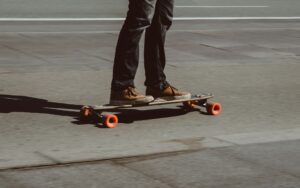

For a stable beginner stance, place your front foot near the front truck bolts and your rear foot near the rear bolts, approximately shoulder-width apart. Keep your knees softly bent, hips centered over the deck and pressure through the middle of each foot. Exact placement varies with deck length, wheelbase, foot size and riding style.
While pushing, the front foot points more toward the nose. After the rear foot returns to the board, rotate the front foot across the deck into a comfortable riding position. Learn this transition at walking speed on flat, traffic-free pavement.
Regular or goofy stance
| Stance | Front foot | Usual pushing foot |
|---|---|---|
| Regular | Left | Right |
| Goofy | Right | Left |
Neither stance is better. The safest way to choose is to test both deliberately on a board that cannot roll, then repeat on level pavement at very low speed. Do not ask someone to push you unexpectedly: a startle reaction is not a reliable stance test and creates an unnecessary fall risk.
The foot you use to kick a ball does not determine your stance with certainty. Use comfort, balance and control over several attempts rather than one “dominant foot” rule.
Three positions beginners need
1. Starting position
Place the front foot over or just behind the front bolts, pointing roughly toward the nose. Bend the front knee enough to support your body while the rear foot remains on the ground. Keep your head up and shoulders relaxed.
- The front foot supports most of your weight.
- The board should remain straight rather than tipping strongly onto one edge.
- The rear foot begins close to the board so the first push is short and controlled.
2. Pushing position
Balance over the front leg and swing the rear leg from the hip. Contact the ground near the front foot and push backward; do not reach far ahead or stamp downward. Start with one small push and return the rear foot to the deck.
Before trying repeated pushes, practise rolling for a moment with the rear foot hovering beside the board. This also prepares the balance required for foot braking.
3. Riding position
Place the rear foot near the rear bolts, then rotate the front foot so both feet sit across the deck at a comfortable angle. They do not need to be perfectly perpendicular. Keep the stance wide enough for stability without stretching to the ends of the board.
- Knees remain soft rather than locked.
- Hips stay over the standing platform.
- Shoulders follow the direction of travel without forcing the torso completely sideways.
- Eyes scan the route instead of remaining fixed on the feet.
Foot-placement reference
| Situation | Front foot | Rear foot | Primary goal |
|---|---|---|---|
| Starting | Near front bolts, pointing forward | On ground beside board | Stable first push |
| Pushing | Forward-facing, supporting weight | Moves backward against ground | Generate speed without steering accidentally |
| Cruising | Rotated across deck | Near rear bolts | Balanced platform for turning and braking preparation |
| Foot braking setup | Turns forward and carries weight | Hovers beside board | Controlled ground contact |
How deck shape changes stance
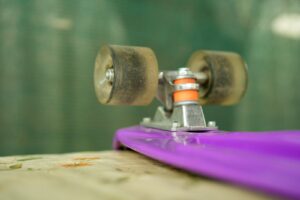
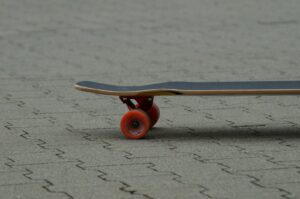
“Stand over the trucks” is a useful starting cue, not a universal law. On a top-mount cruiser, the bolts clearly mark the truck positions. On a drop-through, drop-down or double-drop board, the standing platform and wheel cutouts may determine usable placement more strongly.
- Short cruiser: use the available platform without placing the front foot on the nose or the rear foot unintentionally on the kicktail.
- Drop-through: stay within the main platform and clear of wheel cutouts.
- Drop-down or double-drop: use the lowered platform; the drops can provide clear reference points.
- Dancing deck: begin with a normal cruising stance before adding cross-steps or moving toward the nose.
If you are still selecting a setup, see How to Choose a Longboard and our guide to longboard size and wheelbase.
A five-minute stationary drill
- Place the board on short grass or carpet where it cannot roll.
- Step on in regular stance, then goofy stance. Hold each for 20–30 seconds without gripping with the toes.
- In the more comfortable stance, turn the front foot toward the nose and support your weight over it.
- Lift the rear foot, hover it beside the board and return it near the rear bolts.
- Rotate the front foot across the deck and settle into the riding position.
- Repeat the complete transition slowly until you no longer need to look down throughout the movement.
Stationary practice teaches the sequence, but not moving balance. Transfer it to smooth, flat pavement with a helmet and clear runout.
Common stance problems
Locked knees
A rigid leg position reduces your ability to absorb small surface changes. Keep a slight bend without holding a deep squat. Knee pain has many possible causes; do not assume posture is the only explanation.
Looking at the deck
Brief checks are normal while learning, but staring down limits hazard awareness and often pulls the torso forward. Practise locating the rear foot by touch on a stationary board.
Too much weight on the rear foot
During pushing and foot braking, the front leg must support most of your weight. If the rear foot carries you, ground contact can pull the body away from the board.
Feet too close together
A very narrow stance gives less fore-aft stability. Move toward the bolt areas, but remain within the safe standing platform.
Toes gripping the deck
Curling the toes continuously creates unnecessary fatigue. Relax the feet, reduce speed and rebuild balance with shorter attempts. If discomfort persists, use our responsible guide to foot pain while longboarding.
What this guide does not teach
A downhill tuck, slide stance and freestyle footwork are discipline-specific techniques, not advanced versions of a beginner cruising stance. Do not practise a speed tuck as an invitation to ride hills before you can push, turn and stop reliably. Use the complete beginner riding progression before adding speed or tricks.
Frequently asked questions
Should my feet cover the whole deck width?
No. Some toe or heel overhang is normal. What matters is stable pressure and enough clearance to avoid contacting the wheels or ground unintentionally.
Can I change from regular to goofy?
Yes. Riding with the non-preferred foot forward is called riding switch and can improve versatility. Beginners should first develop reliable control in their natural stance, then practise switch at low speed.
Should I push mongo?
Mongo pushing means keeping the rear foot on the board and pushing with the front. Some riders use it successfully, but it requires more repositioning before steering or braking. Beginners generally find it simpler to keep the front foot planted and push with the rear foot.
Bottom line
Choose regular or goofy by testing both safely. Keep the front foot forward while pushing, rotate it across the deck for riding, and place the rear foot near the rear bolts. Soft knees, relaxed feet and eyes ahead matter more than copying an exact angle from another rider.
Experience note: this guide reflects Juan Campuzano’s longboarding experience since 2010. The positions are practical starting points, not fixed measurements for every deck, rider or discipline.